

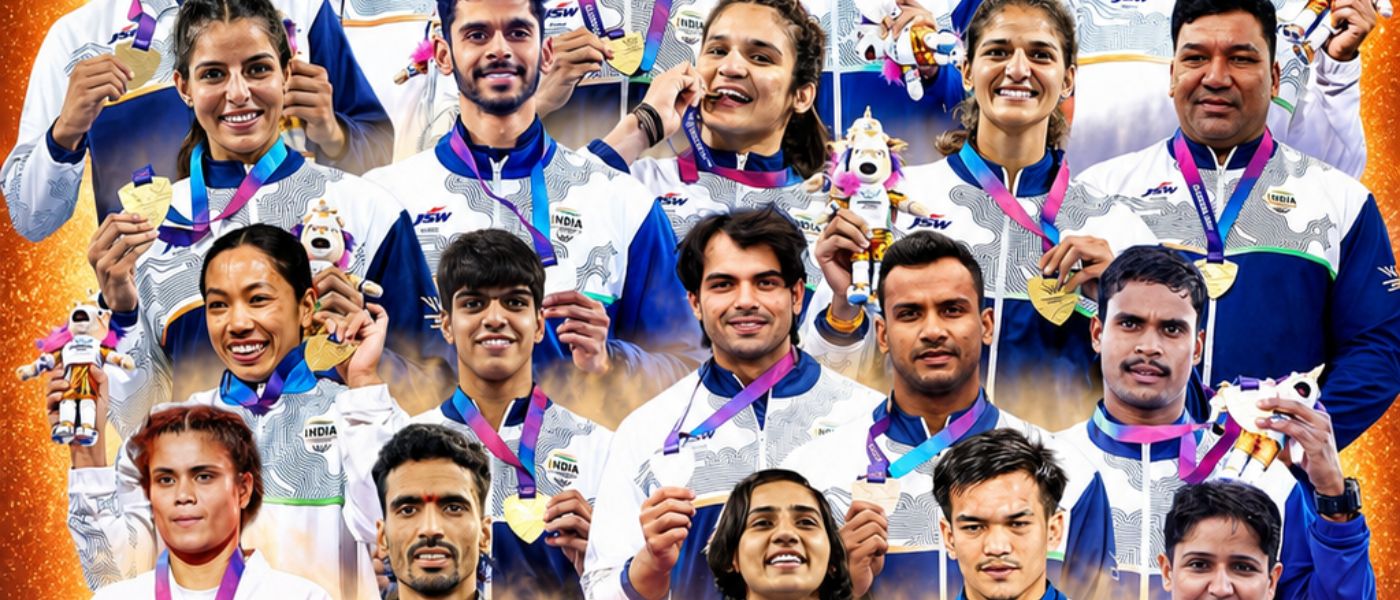
When the curtains came down on the 2026 Commonwealth Games in Glasgow, India stood fourth on the medal table with 39 medals — 13 gold, 17 silver, and 9 bronze. On paper, it is not India’s biggest haul; Birmingham 2022 brought home 61. But by every other measure, Glasgow 2026 will be remembered as one of the most remarkable campaigns in Indian sporting history.
A Games Built for Fewer Chances
Glasgow’s organisers, working with a trimmed-down budget, cut the sporting programme to just 10 disciplines, scrapping several of India’s traditional medal mines — wrestling, badminton, table tennis, hockey, and shooting among them. Historically, these sports alone had delivered a huge share of India’s Commonwealth Games medals. Going into Glasgow, that meant a smaller playing field and a smaller Indian contingent: 122 athletes across eight able-bodied sports and five integrated para sports, competing for a fraction of the opportunities they’d had in Birmingham.
Yet India still finished fourth — level on paper with its best-ever showing in terms of ranking, and arguably its most efficient campaign ever, given how few doors were even open.
The final standings read: Australia on top with a commanding 171 medals (70 gold), England second with 110 (29 gold), Canada third with 62, and India fourth with 39. Host nation Scotland, roared on by its home crowd, had to settle for fifth — behind India.
The Day Everything Changed
For most of the Games, India sat in the unfamiliar territory of the bottom half of the top ten — as low as 10th in the standings with just days to go. Then came a single, extraordinary day.
India’s boxers had reached all 10 finals they contested, and on that decisive day, they delivered like never before: seven gold medals and three silvers from ten bouts — a haul no nation has ever matched in the history of Commonwealth Games boxing, eclipsing the previous best of six golds jointly held by England and Canada. Preeti Pawar and Jaismine Lamboria won gold in the morning session alone, and by the time the last bout ended, India’s boxers had put together the single greatest day any nation has had in the sport at these Games. Sakshi Chaudhary and Olympic medallist Lovlina Borgohain were among the standout performers as the tally swelled to 10 medals overall from the discipline.
On that very same day, India’s judokas made history of their own. Asmita Dey defeated Canada’s Heidi Quach in a nail-biting Golden Score finish to become the first Indian judoka — man or woman — to win a Commonwealth Games gold medal, in the women’s -48kg category. Minutes later, Harsh Singh doubled the celebration, upsetting Australian Olympian Joshua Katz to win gold in the men’s -60kg. Yamini Mourya added a silver in the women’s -57kg, rounding off judo’s greatest single day at the Games. The same afternoon also brought a historic double podium in javelin, with Neeraj Chopra taking silver (85.83m) and Yashvir Singh bronze (85.41m) — the first time two Indian javelin throwers had stood on a Commonwealth Games podium together — while Tejaswin Shankar added a bronze in the decathlon.
Between boxing’s golden afternoon and judo and athletics’ historic evening, India rocketed up the table — a single day’s work turning a 10th-place finish into a top-four campaign.
Firsts That Will Be Remembered Longer Than the Final Tally
What made Glasgow special wasn’t just the number of medals — it was how many of them were the first of their kind for India.
- Boxing’s greatest day ever: India’s seven boxing golds in a single edition is a record no country has matched.
- Judo’s breakthrough: Asmita Dey and Harsh Singh delivered India’s first-ever Commonwealth Games gold medals in judo, a sport where the country had never before stood on the top step.
- Distance running history: Gulveer Singh became the first Indian to win a men’s 10,000m medal at the Commonwealth Games, taking silver in a rain-soaked 27:49.78. Days later, he added a bronze in the 5,000m, becoming the first Indian athlete to win two individual track medals at a single edition of the Games.
- Javelin’s first double podium: Neeraj Chopra and Yashvir Singh’s silver-bronze finish marked the first time India had two men on the javelin podium together.
- Para sport’s finest hour: India’s para contingent delivered its best-ever Commonwealth Games campaign, winning seven medals — three gold, two silver, two bronze — matching the country’s combined para medal tally from every previous edition put together. Sharmila Dhankar became the first Indian para-athlete to win a Commonwealth Games para-athletics gold, taking the women’s shot put F57 title with a season-best 9.81m and ending a 20-year Indian wait for a Commonwealth Games para-athletics medal. Soman Rana, a former Army havildar who lost part of his leg to a landmine blast, followed her by winning the men’s shot put F57 gold — India’s first in that event too — with Shubham Juyal adding silver for a second Indian double podium in para athletics, alongside Dilip Gavit and Mohammed Basil’s gold-silver finish in the men’s 100m T47.
- A courageous decathlon bronze: Tejaswin Shankar was forced to withdraw from the high jump final midway through the Games with a flare-up of long-standing patellar tendinitis. Two days later, competing through the same injury, he fought through all ten decathlon events to win bronze — India’s first-ever Commonwealth Games medal in the discipline, and his second individual medal at the Games after his 2022 high jump bronze in Birmingham.
Why Fourth Place Means So Much
India’s all-time best Commonwealth Games finish by medal count remains Birmingham 2022, where a full sporting programme yielded 61 medals. But Glasgow 2026 offered barely half the disciplines, stripped away several of India’s most dependable medal-winning sports, and still India finished fourth overall with 13 gold medals — matching its position from previous Games despite dramatically reduced opportunities. That context is why boxing’s heroics, judo’s breakthrough golds, and the para-athletes’ record-equalling campaign are being spoken of as one of India’s proudest showings at the Games, regardless of what the final medal count says next to Birmingham’s.
Looking Ahead
With Glasgow behind them, Indian athletes now turn their attention to the next major multi-sport event on the calendar: the Asian Games, scheduled to begin on September 17, 2026.